

If you live with chronic pain, chances are you've spent a lot of time trying to understand why.
You've seen specialists. You've researched symptoms. You've tried stretching routines, supplements, medications, physical therapy, ergonomic chairs, heating pads, and every recommendation that someone swore would finally be the thing that helped. And yet, the pain remains.
For many people, chronic pain can feel confusing and deeply discouraging. Especially when there is no clear explanation, or when the severity of the pain seems disproportionate to what imaging or medical tests reveal.
In recent years, researchers and clinicians have begun exploring a more complete understanding of chronic pain. Not because the pain is "all in your head," but because pain is far more complex than we once believed.
One of the most fascinating aspects of this work is the observation that certain personality traits appear again and again among people living with chronic pain. Not because those traits cause pain, but because they can contribute to a nervous system that rarely feels safe enough to fully relax.
The idea that emotions, stress, and personality patterns can influence chronic pain is not entirely new.
Decades ago, physician Dr. John Sarno challenged the prevailing belief that chronic pain was always the result of structural damage. Through his work with patients experiencing persistent back, neck, and other pain conditions, he observed that many shared common psychological traits, including perfectionism, people-pleasing, conscientiousness, and a tendency to place enormous pressure on themselves.
Sarno believed that emotional stress and unresolved internal conflict could contribute to physical symptoms in ways that were often overlooked by traditional medical models.
While our understanding of pain has evolved considerably since Sarno first introduced these ideas, modern pain science has continued to explore the complex relationship between the brain, nervous system, emotions, and chronic pain.
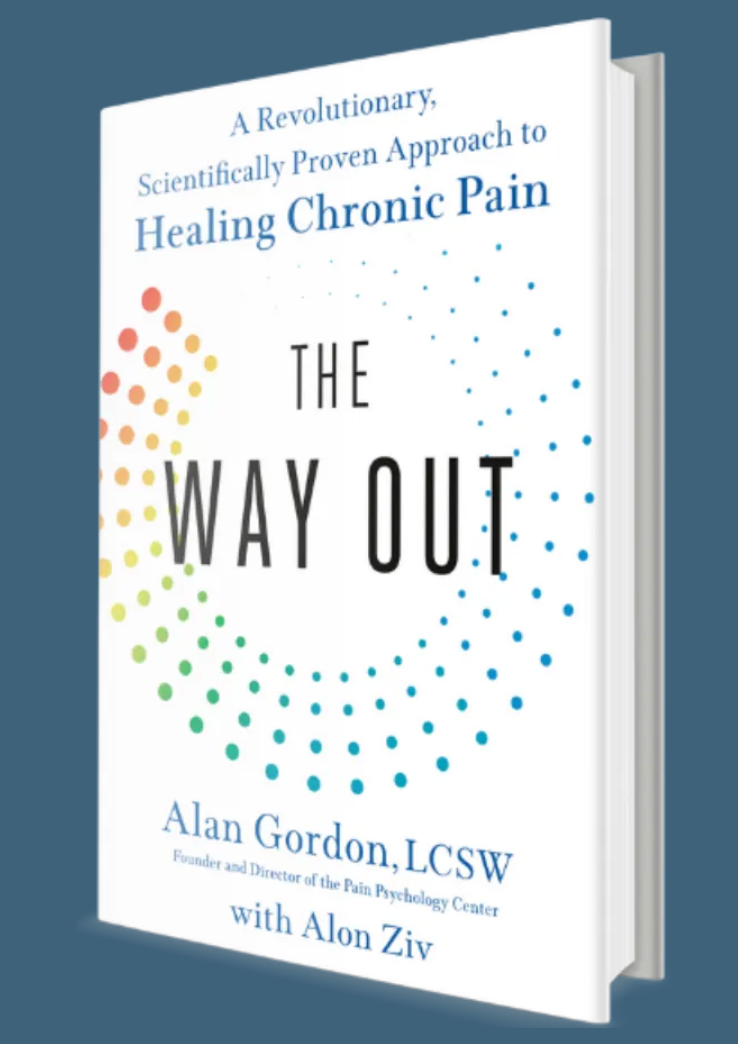
One voice that has helped bring this perspective into public conversation is Dr. Alan Gordon, founder of the Pain Psychology Center and author of The Way Out. Through his work on Pain Reprocessing Therapy, Gordon explores how chronic pain can sometimes persist even after tissues have healed because the nervous system continues sending danger signals. In other words, pain is always real. But sometimes the source of the pain is less about structural damage and more about a nervous system that has become stuck in a state of protection.
For some people, this perspective feels deeply validating. For others, it can feel frustrating, confusing, or even dismissive at first. If you've spent years searching for answers, that's understandable. Learning about the mind-body connection is not about denying your pain. It's about expanding the lens through which we understand it.
Many of the people I work with who struggle with chronic pain are the people everyone else depends on. They are the reliable partner. The dedicated employee. The parent who remembers every appointment, signs every permission slip, and keeps track of what everyone needs. They are often thoughtful, conscientious, caring, and deeply responsible. They are also frequently exhausted.
Dr. Gordon and others in the mind-body pain field have observed that people living with chronic pain often share certain characteristics:

None of these qualities are inherently negative.
In fact, they are often traits that are celebrated and rewarded. These are the people who get promoted. The people others trust. The people who are praised for their work ethic, reliability, and commitment.
But there is a hidden cost. Many high achievers carry an internal belief that they must always do more, be better, or work harder. Rest feels uncomfortable. Mistakes feel threatening. Letting someone down can feel intolerable.
Even when there is no immediate crisis, the body remains on alert. Always scanning. Always preparing. Always carrying. Over time, this constant state of vigilance can take a toll.
One of the most important things modern pain science has taught us is that pain is not simply a measure of physical injury. Pain is the brain and nervous system's way of protecting us.
When you accidentally touch a hot stove, pain serves an obvious purpose. It tells you to pull your hand away. But chronic pain often operates differently. Sometimes the nervous system becomes so sensitized that it continues perceiving danger even when there is no ongoing injury. The alarm system stays switched on.
Imagine a smoke detector that becomes so sensitive it goes off every time someone makes toast. The alarm is real. The sound is real. The distress is real. But the alarm system is misinterpreting the level of threat.
This is part of what Pain Reprocessing Therapy seeks to address. Rather than focusing exclusively on the body part that hurts, it helps people understand the relationship between fear, attention, stress, emotions, and the nervous system's perception of danger.
For many people, this understanding alone can be profoundly relieving because it offers an alternative to the exhausting belief that their body is broken. Instead, it suggests something much more hopeful: Your nervous system may be trying very hard to protect you. It may simply need help learning that it is safe.
One of the challenges for high-achieving people is that they are often remarkably good at functioning under stress. They push through discomfort. They meet deadlines. They show up for others. They keep going.
For years, these abilities may be seen as strengths. And they are strengths. But sometimes the very qualities that help people succeed professionally or socially make it harder to recognize when they are operating beyond their limits.

By the time chronic pain develops, many people have spent years ignoring signals from their bodies. Signals that might have sounded like:
"I'm overwhelmed."
"I need support."
"I'm carrying too much."
"I can't keep doing this alone."
Instead, they respond with what has always worked: Try harder. Push through. Keep going. Eventually, the body may begin speaking more loudly.
At this point, some readers may be wondering: "Are you saying my pain is all in my head?"
The answer is a resounding no. Pain that originates from the nervous system is still real pain. You are not imagining it. You are not making it up.
Understanding the role of the nervous system does not invalidate the physical experience of pain. In fact, many people find it validating because it finally explains why symptoms persist even when medical testing fails to provide clear answers. The goal is to recognize that the nervous system may be playing a larger role than previously understood. And that means change is possible.
Perfectionism is frequently misunderstood as simply wanting things done well. But in therapy, perfectionism often reveals itself as something much deeper.
Many perfectionists carry an underlying belief that mistakes are dangerous. That their worth is tied to performance. That they need to earn approval, love, belonging, or safety. These beliefs rarely appear out of nowhere.
For some people, they develop in childhood environments where achievement was heavily valued. For others, they emerge in families where emotional needs were minimized, ignored, or treated as burdens.
As I wrote about in Growing Up Unseen: How Having Emotionally Immature Parents Affects You Today, many adults learned very early to become experts at reading other people's needs while losing touch with their own.
They learned to be helpful. Responsible. Easy. Self-sufficient.
Over time, those adaptations can become so automatic that they no longer feel like choices. They simply feel like who you are. But constantly monitoring yourself and managing everyone around you requires an enormous amount of energy. And eventually, the body notices.

Even people who have successfully managed perfectionistic tendencies for years may find those patterns intensify during major life transitions.
I often see this happen during infertility, pregnancy, and early parenthood.
These experiences ask us to tolerate uncertainty in ways that many high-achieving people find particularly challenging.
There is no perfect way to conceive. No perfect pregnancy. No perfect birth. No perfect parent. And yet many people find themselves trying.
The same qualities that make someone conscientious and devoted can also make it difficult to rest, ask for help, or trust that they are already doing enough.
I often think about the clients who come into therapy exhausted from carrying responsibilities that no one else can see—managing appointments, researching every possible outcome, monitoring symptoms, trying to prevent mistakes before they happen, holding everyone else together.
Eventually, what begins as care can become chronic vigilance. And chronic vigilance is exhausting for a nervous system.
One thing I find myself returning to again and again is that perfectionism is often rooted in grief. Not always obvious grief, but grief nonetheless.
The grief of not feeling fully seen.
The grief of believing your value comes from what you do rather than who you are.
The grief of spending years trying to earn something that should have been freely given.
Sometimes chronic pain invites people into a conversation they have been avoiding for a very long time. Not because pain is a punishment, but because the body can become impossible to ignore.
Many clients discover that beneath the pressure to perform is a profound longing to be accepted as they are.
Healing from chronic pain is rarely as simple as finding the perfect treatment. More often, it involves developing a different relationship with yourself.
For some people, that means learning to notice when their nervous system is interpreting stress as danger. For others, it means becoming less afraid of symptoms.
For many, it involves practicing something that feels surprisingly difficult: Self-compassion.

Healing may include:
These changes do not happen overnight. But they can create the conditions for a nervous system that feels safer, calmer, and less burdened.
When chronic pain intersects with perfectionism, anxiety, grief, relationship stress, or major life transitions, therapy can offer an important place to slow down and explore the full picture.
In my work in Montclair, NJ, I help individuals understand the emotional and relational patterns that may be contributing to chronic stress and nervous system activation.
The goal is not to prove that pain is psychological. The goal is to understand what your mind and body may be carrying together.

If you struggle with chronic pain, your body is not your enemy. And your pain is not evidence that you have failed to heal correctly.
Sometimes the traits that helped you survive, succeed, and care for others are the very traits that eventually ask for your attention. Not because they are wrong, but because they have been working overtime for a very long time.
Healing often begins not by trying harder, but by becoming curious. Curious about what your nervous system has been protecting. Curious about what your body has been carrying. And curious about what might become possible if you no longer demanded perfection from yourself.

