

If you've been on Instagram recently, you may have seen Congresswoman Alexandria Ocasio-Cortez doing something women have historically experienced much more privately: freezing her eggs.
AOC began documenting the process during her August recess, sharing everything from giving herself hormone injections to fitting fertility appointments into an already demanding professional life. In explaining her decision, she described egg freezing as a choice that would help her feel more in control of her life.
She's not the first woman to make this experience public. A few years ago, Monica Padman and Liz Plank documented their own egg-freezing journeys on the podcast Race to 35. Over ten episodes, listeners followed along with the hormone shots and appointments, but also the evolving fears, joys, questions, and complicated feelings that came with confronting fertility at 35.
I'm glad these conversations are happening more publicly, because the medical process is only part of what a woman may experience when she decides to freeze her eggs.
As a Montclair-based psychologist who works with women navigating fertility, pregnancy, and other major life transitions, what interests me isn't whether someone should freeze her eggs. That's an extraordinarily personal decision. I'm interested in everything the decision can bring to the surface.
Because egg freezing isn't just about fertility. It can bring you face-to-face with questions about time, control, relationships, identity, motherhood, and a future you can't actually see yet.
There is something genuinely empowering about being able to preserve reproductive options that previous generations of women didn't have.
Research reflects this. In one prospective study of women considering planned egg freezing, 95% of those who ultimately froze their eggs said they felt good about having taken some control over their future hopes of having children, and 91% felt the decision gave them more options for planning a family.
But empowerment isn't the only possible emotion.
Choosing to freeze your eggs can also require acknowledging something you may have previously understood intellectually without having to confront quite so directly: your fertility isn't infinite.
Maybe you thought you would have met someone by now. Maybe you have a partner but neither of you is ready. Maybe you're not sure whether you want children at all, but you don't want today's uncertainty to make the decision for your future self. Maybe your life simply unfolded differently than you imagined it would.
For some women, egg freezing enters the picture for a different reason: they are preparing for chemotherapy, radiation, surgery, or another medical treatment that could affect fertility. In those situations, fertility preservation may be part of an urgent medical plan rather than a decision prompted primarily by age, relationships, or uncertainty about when to have children. The emotional experience can be especially complicated when someone is trying to care for her health while also grieving the possibility that treatment may change her reproductive future.
There can be grief in that, even when freezing your eggs feels like exactly the right decision.
You can be grateful this technology exists and wish you didn't have to think about it. You can feel relieved and frightened. You can feel hopeful about the future while grieving the version of your life you once assumed would have happened by now. Those feelings don't cancel one another out.
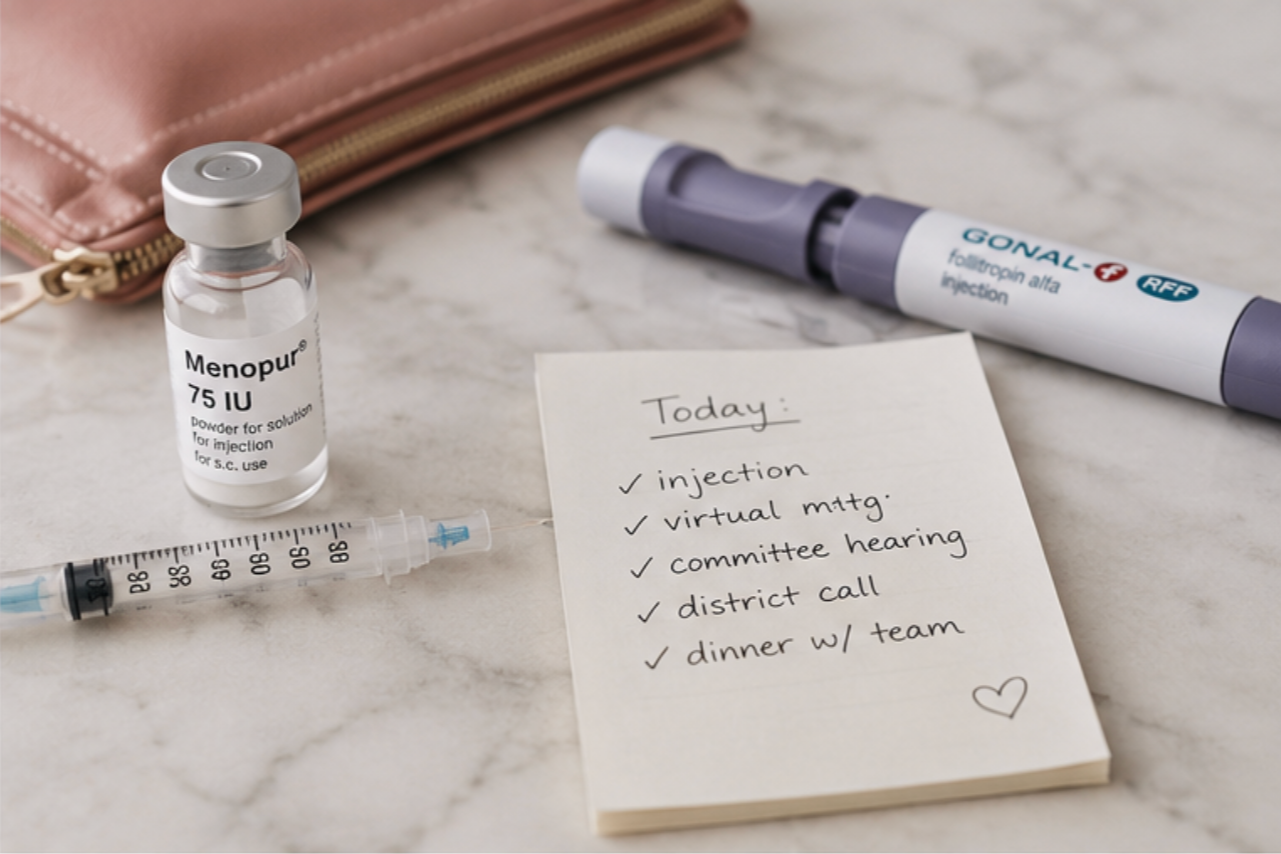
One of the psychologically interesting things about fertility treatment is how much structure it introduces into an area of life that is fundamentally uncertain.
There are medications to order. Injections to administer at particular times. Appointments to attend. Follicles to measure. Instructions to follow. Eventually, there is a retrieval date.
For someone who copes with uncertainty by researching, planning, organizing, or trying to do things "right," that structure can actually feel comforting.
There is a plan.
There is something you can do.
I've written before about this dynamic in infertility, particularly around sleep and the enormous list of things women can begin to feel responsible for getting right when they're trying to conceive. Sleep enough, but not too much. Exercise, but not too intensely. Eat the right things. Take the supplements. Reduce your stress. Don't drink. Watch your caffeine.
Egg freezing can offer a temporary counterpoint to all of that ambiguity. Here is the medication. Here is the dose. Here is when you take it.
But eventually, even this highly structured process runs into uncertainty.
You can follow every instruction perfectly and still not control how your body responds. You cannot know exactly how many eggs will be retrieved, how many will be mature, whether you will eventually need them, or whether those eggs will one day result in a baby.
Egg freezing creates possibilities. It doesn't create guarantees. And perhaps that is part of why the experience can feel so psychologically complicated. You're taking meaningful action in an area of life where action can only take you so far.
In some ways, this is also strikingly similar to what motherhood itself eventually asks of us. Parenthood gives you endless opportunities to research, prepare, plan, and try to make the best possible decision. But it also repeatedly confronts you with the limits of your control.
You can care deeply without being able to guarantee an outcome. For women accustomed to believing that enough effort produces the desired result, that can be a very uncomfortable truth.

There's another unusual aspect of freezing your eggs that I don't think we talk about enough. You're undergoing a medical procedure today on behalf of your future self. And you don't know her yet.
Will she want children?
Will she have a partner?
Will she conceive without needing these eggs?
Will she decide she doesn't want children after all?
Will she be grateful you froze them?
Will she wish you had done another cycle?
Will her life look anything like the one you're currently imagining for her?
There is something both loving and strange about making a significant financial, physical, and emotional investment to preserve options for a version of yourself whose life you cannot predict.
It can also create a particular kind of responsibility: What do I owe my future self?
If freezing my eggs now might give her another option later, should I do it? If my retrieval doesn't produce the number I hoped for, should I do another cycle? How much is enough to feel like I've done everything I reasonably can?
These aren't simply medical questions. They're questions about uncertainty, responsibility, hope, and how much of the future we believe we should be able to protect ourselves from.
One of the things I appreciate about AOC documenting her experience is how visible she has made the logistics of egg freezing.
The injections and appointments aren't happening in a vacuum. They're happening while she continues being a member of Congress.
Most women aren't fitting fertility treatment around congressional responsibilities, of course. But they may be giving themselves injections before an 8 a.m. meeting. Rearranging work around monitoring appointments. Taking medication into an office bathroom. Answering emails while waiting for bloodwork. Managing physical discomfort while presenting to colleagues who have no idea what is happening.
From the outside, life can look remarkably normal.
Internally, you're tracking appointments, medications, hormone levels, follicle counts, physical symptoms, costs, scheduling, and an enormous amount of uncertainty.
It can become an invisible second job layered on top of the life you were already living.
Recent research on women undergoing planned egg freezing found exactly this kind of complexity. Stress wasn't limited to concerns about fertility itself. Women reported financial considerations, medication management, physical and logistical demands, work-related stress, questions about support, and uncertainty about the future.
This matters because you may be functioning perfectly well and still be carrying a lot.
You don't have to be falling apart for something to be emotionally demanding.

Fertility medicine involves a lot of numbers.
Age. AMH. Follicles. Eggs retrieved. Mature eggs. Eggs frozen. Estimated probabilities of future success.
Those numbers are medically useful. But they can become emotionally symbolic very quickly.
Twelve eggs can start to feel like hope. Four can start to feel like failure. Neither interpretation actually captures what those numbers mean.
A large systematic review of planned egg freezing found that outcomes vary considerably, with age at the time eggs are frozen playing an important role in later outcomes. Egg freezing can improve the possibility of conceiving at a later reproductive age, but it isn't an insurance policy for a future baby.
Interestingly, AOC has chosen not to publicly share her own egg counts. She explained that she didn't want other women comparing their biology with hers or making a major reproductive decision based on one person's numbers. She also acknowledged that hearing someone else's numbers can be difficult for people who have experienced infertility or pregnancy loss.
I think there's something psychologically important in that choice.
Once fertility becomes quantified, it can be very difficult not to assign meaning to the numbers. Especially if you're someone who has spent much of your life achieving measurable outcomes.
Study hard enough and you can improve the grade. Work hard enough and you can earn the promotion. Train consistently and you can improve your time.
Fertility doesn't always obey that equation.
Your egg count is information about a medical process. It is not a grade on how well you did fertility.
So much attention goes toward getting through retrieval that there may be less conversation about what happens emotionally afterward.
For weeks, your life has revolved around something concrete. You're administering medication, monitoring your body, attending appointments, receiving new information, and moving toward a specific date.
Then the retrieval happens.
The eggs are frozen.
And life resumes.
Maybe you feel enormous relief. Maybe you feel proud of yourself. Maybe you're disappointed by the outcome. Maybe you're considering another cycle. Maybe you feel physically and emotionally depleted. Maybe you expected to feel different afterward and are surprised that you don't.
Research suggests this period can be more complicated than simple relief. In one study, 20% of women who froze their eggs reported feeling disappointed with the outcome of their cycle, and 19% said they actually felt more anxious about their future fertility afterward.
More recent research has similarly found that while some of the procedural stress recedes after egg freezing, it can be replaced by concerns about outcomes and the future. Because the procedure may be finished, but the question that led you there hasn't necessarily been answered. You still don't know what your future family will look like.
I don't think the lesson here is that women need to "let go of control."
That feels far too simplistic.
There is value in taking action where action is available. There can be enormous comfort in knowing that you've given your future self another possibility. For some women, egg freezing may genuinely relieve some of the pressure they feel around relationships, timing, and fertility.
But there is also emotional work in recognizing the boundary between preparation and control.
You can make thoughtful decisions without knowing exactly where they'll lead. You can invest in your future without knowing precisely what that future will look like. You can hope deeply for something without being able to guarantee it.
In many ways, these are skills that extend far beyond fertility.
Pregnancy asks them of us. Parenthood asks them of us. Relationships ask them of us. Grief certainly asks them of us.
The goal isn't to care less about what happens. It's learning how to care deeply while still making room for uncertainty.

If you're considering freezing your eggs, preparing for a cycle, or sitting with complicated feelings after retrieval, you don't need to be in crisis for therapy to be useful.
Fertility appointments understandably focus on the medical questions. Perinatal therapy can make room for the questions that don't fit as neatly into an appointment with your reproductive endocrinologist.
What does it mean that my life doesn't look the way I thought it would by now? Do I actually want children, or am I afraid of losing the option? How do I date when fertility suddenly feels like it has a timeline attached to it? Why am I so disappointed in my body? Why can't I stop researching? How do I know when I've done enough?
Sometimes the work is grief. Sometimes it's anxiety. Sometimes it's relationships, identity, perfectionism, or the exhausting belief that if you gather enough information and make every decision correctly, you can protect yourself from regret.
In my Montclair practice, I work with women navigating infertility, fertility preservation, pregnancy, postpartum experiences, and the complicated transitions surrounding motherhood. Therapy isn't about telling you what reproductive decision to make. It's about giving you a place to understand what the decision means to you.
Egg freezing can give your future self more options.
You don't have to know exactly what she'll do with them yet.

